Tuesday, August 08, 2023

OIL PRICES CONTINUE TO RISE

EL TALADRO AZUL    - Published  originally in Spanish in LA GRAN ALDEA

M. Juan Szabo and Luis A. Pacheco


The two big OPEC+ producers, Saudi Arabia, and Russia, seem to be playing in tandem to prop up oil prices. The Saudis announced their intention to maintain their voluntary production cuts until September, or longer, if necessary: while the Russians announced that they will restrict their exports in September. These two announcements and a robust demand were enough to propel oil prices, maintaining the upward trend of the last six weeks.

The report of the unusual drop in US crude inventories of 17 MMbbls, which is probably a correction to previously reported figures, indicates a less comfortable market than previously reported. On the other hand, the Ukrainian attack on Friday, August 4, on the Russian oil terminal, Novorossiysk, in the Black Sea, caused the closure of the port, affecting oil shipments; two Russian ships were seriously damaged and had to be towed to port to stop them from sinking. This has generated understandable nervousness in the oil market, adding “fuel” to prices.

Saudi Arabia is pushing hard with its strategy of tightening oil production to increase prices. Not all the members of the cartel agree with this maneuver, since it is interpreted not as an action aimed at benefiting the group, but as a strategy designed to benefit the ambitious development projects of the Crown Prince. The members of OPEC+, in their virtual meeting on Friday, analyzed the prospects for oil demand, limiting themselves to publishing a statement informing that they would adjust production levels depending on market conditions.

This warning from OPEC+ comes in an environment in which oil demand does not seem to give way, remaining at 102 MMbpd, but with prospects that, at some point, the continued restrictive policy of the Central Banks will erode demand. Uncertainties surrounding China's economic growth complement the factors that mitigate demand growth.

The Chinese economy expanded by 6.3% in the second quarter of 2023, showing faster growth compared to the 4.5% registered in the first quarter, but falling short of analyst projections of 7.3%. Beijing has restricted stimulus measures to the economy because, among other things, local government debt has skyrocketed. The latest economic indicators presented a mixed picture: retail sales increased at a much slower pace, while industrial production growth accelerated. The urban unemployment rate was unchanged at 5.2%, but youth unemployment hit a new high of 21.3%. So, for now, China does not appear to be a driver of demand.

In the US, the risk rating agency, Fitch, announced a reclassification of the US debt, downgrading it from AAA to AA+. In May of this year, Fitch had placed the AAA rating under negative observation, on discussions in Congress on debt limits and which almost left the administration in a situation of default.

Fitch downgraded the United States debt, citing fiscal deterioration over the next three years and renewed debt ceiling negotiations that threaten the government's ability to pay its bills. It is the second most important rating agency after Standard & Poor's to strip the US of its triple-A rating. The decision was cataloged, mainly by the Biden administration and its associates, as untimely and risky due to the harmful effects that could trigger globally. Furthermore, bankers of the stature of Jamie Dimon, chief executive of J.P. Morgan, criticized the move, even calling it “ridiculous”. In a television interview, Dimon declared that “it (the downgrading) really doesn't matter that much” because it is the market, not the rating agencies, that determines borrowing costs. But despite the criticism, the news rocked the markets.

US non-farm jobs numbers, reported this Friday, August 4, indicated an increase of 187,000 in July, below what was expected. The unemployment rate remained at 3.5%. Most of the jobs created are in the health care, social assistance, financial activities, and wholesale trade sectors. The data seems to indicate that the labor market is cooling-off enough to support a possible soft landing for the world's largest economy.

Also in the US, the reduction in drilling activity continues. Baker Hughes reported a net reduction for the week of 5 units. This time, the reduction coincides with a reduction of 11 rigs in the rest of the world, which corresponds to a combination of increased activity in Algeria, Ukraine, and Saudi Arabia, but reductions in Colombia, Canada, Ecuador, and Guyana.

Thus, the supply is limited by the combination of OPEC+ cuts, general production capacity decline due to lower generation activity, and unanticipated limitations due to accidents, and war, among others.

In short, the developments of this first week of August had a net positive effect on the oil market. At the close of the markets on Friday, August 4, the marker crudes were trading at $/bbl 86.24 and $/bbl 82.82 for Brent and WTI respectively. The highest prices since mid-April 2023.

Other news of interest for the energy market:

·       A recent US government report shows that subsidies for renewable energy producers doubled between 2016 and 2022, accounting for nearly half of all energy-related federal support in that period. Renewable energy subsidies increased to $15.6 billion in fiscal year 2022, from $7.4 billion in fiscal year 2016. Most of those subsidies (70%) took the form of tax incentives.

·       Trafigura Group, and its operating partner Chemaf  SA, have announced that they need to increase the financing of their copper and cobalt project in the Democratic Republic of Congo, due to a considerable increase in the investment budget:-more than 30%, according to information from Bloomberg.

·       Guyana, the latest country to become an oil exporter, has again postponed the date for its first competitive auction of new offshore blocks, delaying the licensing round, for the third time, to September 12. The delay is due to the search for the optimal “modern regulatory framework”. I hope that the government understands that the perfect is the enemy of the good, a concept upon which politicians from many countries have stumbled.

·       The situation in Libya is improving – The Libyan National Oil Corporation announced that ENI and BP would lift their force majeure in Libya and resume exploration activities in the western regions of the country.

·       Saudi Arabia and Kuwait reiterated on Thursday that the natural gas resources in a field under dispute with Iran: “are the exclusive property of the Kingdom of Saudi Arabia and Kuwait. The two countries have full sovereign rights to exploit the resources of the area,” the Saudi press agency said, reporting a statement by the Saudi Foreign Ministry. The dispute sparked earlier this year when Iran announced plans to start drilling in the field, which they call Arash, while Kuwait and Saudi Arabia call it Durra.


Energy transition

Copper, the indispensable metal

Every time we flip the switch to magically displace the darkness in our room, turn on the washing machine or listen to music, not to mention activate the X-ray machine, or the spectrograph, or charge the ubiquitous cell phone, we are being benefited by the flow of electrons along the conductor wire that connects us with one of the greatest wonders of modernity: electricity. All of this is made possible thanks, among other reasons, to a modest and quiet but indispensable protagonist: copper, from which most of the cables that conduct electricity are made.

The widespread use of copper by ancient societies seems to originate in the Neolithic period. The shiny, reddish-brown metal was used in jewelry, tools, sculpture, bells, vessels, and death masks, among other things. Its importance in human development gave its name to the Copper Age, better known today as the Chalcolithic.

In many regions of the ancient world, copper was readily found in its metallic form, albeit in relatively small quantities. This metal was first used in the Balkans, the Middle East, and the Near East between 8,000 and 3,000 BC. Over time, Egypt and Europe adopted this practice and began creating their copper artifacts. Due to its softness and malleability, copper was an ideal material for the production of luxurious decorative goods.

Copper was made even more useful by mixing or alloying it with other materials or metals to make an alloy of higher strength. Thus, brass arose, an easier material to melt, which was formed with copper and zinc. And bronze, which was made by joining copper with arsenic, antimony, or tin.

The development of bronze was an important milestone in human history, as it allowed for the creation of more durable and versatile tools and weapons than those made of stone or other materials.

The Bronze Age (3300 to 1200 BC), characterized by the widespread use of the novel metal, revolutionized human societies and laid the foundation for new technological advances in metallurgy and civilization in general. It is not difficult to imagine the legendary Achilles at the gates of Troy wearing his bronze armor and sword, which, according to Homer in the Iliad, was made at the request of his mother, the goddess Thetis, by the god of fire, Hephaestus.

With the onset of the Industrial Revolution in the 18th century, copper became an integral part of the development of modern infrastructure, transportation, and communication systems. Copper's malleability and corrosion resistance also made it a preferred material for roofing, plumbing, and coinage.

In the early 19th century, the British scientist, Humphry Davy, made significant contributions to the field of electromagnetism. He conducted experiments with electric currents and demonstrated that copper wires were highly conductive, leading to their use in early telegraph systems.

However, it was Michael Faraday, a British scientist, who made groundbreaking discoveries about the suitability of copper for electrical applications. In the early to mid-19th century, Faraday conducted extensive research on electricity and magnetism. He formulated the laws of electromagnetic induction and discovered the concept of electric and magnetic fields.

Faraday's work paved the way for practical applications of electricity, and he was the first to demonstrate the use of copper wires in the transmission of electrical power. His experiments and discoveries laid the foundation for the development of electrical engineering and the widespread use of copper in electrical systems. His work led, among other things, to the development of the electric motor, ubiquitous in our present and future.

Copper processing is a complicated process that begins with mining the ore (containing less than 1% copper) and ends with sheets of 99.99% pure copper, called cathodes. In the contemporary era, copper mining and production methods have evolved significantly. The most commonly mined types of ore are copper oxide and copper sulfide. Copper oxide, although more abundant, is a low-grade mineral that can be mined near the surface. Copper sulfide has a higher copper content than copper oxide, but is more expensive to process.

The two main methods of extracting copper are open-pit mining and underground mining. Open pit mining involves the removal of waste and waste material to access copper ore below the surface. This method is more common and cost-effective for mining low-grade copper deposits. On the other hand, underground mining is employed when higher-grade copper ores are present deeper in the earth. This method requires tunneling into the ground to access the valuable mineral.

The copper extraction process involves several stages, including crushing, milling, and concentration of the ore to obtain copper concentrates. These concentrates are then smelted at high temperatures to separate the copper from impurities, resulting in blister copper. The most common types of ore, copper oxide, and copper sulfide, undergo two different processes, hydrometallurgy (wet) and pyrometallurgy (dry), respectively, due to the different chemistries of the ore. Since a mine is unique in its mineral composition, concentration, and quantities, mine planners must determine the most economical and cost-effective processing of the mineral. When economically feasible, a mine may extract both types of copper ores; where this is not possible, mines will only process copper oxides or copper sulfides.

In any case, the financial, mechanical, and chemical effort of mining and refining copper is considerable, and although it is not our focus here, it is important to understand the scale of the operation. For example, the typical extraction ratio in an open pit copper mine is usually greater than 3:1, that is, 3 tons of waste must be removed for every ton of copper-bearing rock. Assuming that the ore grade is typically less than 5% for copper, from one ton of rock, only 50 kg of the metal can be obtained (not counting refining losses); the rest is also added to the waste that the mine must handle.

According to Copper.org, an average single-family home uses 200 kg of copper. If we use the relationships described above, that family is responsible for the extraction of more than 12 metric tons in a mine in Chile or Peru.

An energy system powered by non-fossil energy technologies is very different from one powered by traditional hydrocarbon resources, especially in terms of its intensive use of metals. Photovoltaic cells, wind farms, and electric vehicles, to name a few examples, generally require many more metals in their manufacture and utilization than their traditional counterparts.

A typical electric car requires six times more minerals than a conventional car, and an onshore wind farm requires nine times more mineral resources than a natural gas power plant. In particular, an electric vehicle (EV) requires almost 2 and a half times the amount of copper as a gasoline-powered car, in addition to other minerals such as lithium and nickel that are only used by the EV.

In the various energy transition scenarios that are talked about, the demand for copper increases significantly. Most of this new demand is associated with the growth of electric vehicles and new transmission networks, as well as the massive deployment of solar and wind energy.

According to the International Copper Study Group , around 20 million metric tons (MMtm) of copper were produced in 2021. Chile is the largest producer (28%), followed by Peru (11%), China (9%), and Congo; Latin America produced 8.7 MMtm, 41% of the total. On the other hand, the copper used in final products is the product of refining processes; in 2021, China, Chile, and Japan produced more than 50% of the volume of refined copper.

The same publication reports that in the same period, world copper reserves were of the order of MMtm 880. Chile (26%), Australia (13%), and Peru (11%) appear as the countries with the largest volumes of reserves. The United States Geological Survey (USGS) estimates that the identified and undiscovered resources add up to around 5,600 MMtm.

Although as of today, there seems to be enough supply to satisfy the demand for copper in the short term, in the medium and long term the story seems different. According to the IEA, existing mines face challenges beyond 2024: Chile faces declining ore quality and water shortages, while protests by local communities could disrupt Peruvian supplies. Furthermore, the agency notes that the lack of new large-scale, high-quality projects indicates that the growth rate of production may slow after 2024.

This implies that the market could have a shortage if demand increases due to the recovery of the Chinese economy and the acceleration of energy transitions, which would, of course, have long-term price implications.

According to the vision of the Royal Bank of Canada (TSE: RY), at the present rate of growth of EVs, renewable energy, and new transmission lines, a potential supply shortfall of 10 MMtm can be foreseen by 2035.

Fortunately, copper is easily recyclable. It is estimated that two-thirds of the 690 million tons of copper produced since 1900 are still in productive use. And that a third of the annual demand is covered by copper from recycling.

In short, copper will continue to be the conducting artery of the electricity industry, regardless of which model of energy transition, we assume. And it represents, for Latin America, an opportunity for the future. While at the same time, it represents one of the most important balance loops in the energy transition scenarios since their materialization largely depends on their supply.

Venezuela

Political Events and Others

The progress of the primary election process organized by the opposition, coupled with the consolidation of potential voters behind the campaign of Mrs. María Corina Machado Parisca (MCM), is leading the regime to extreme reactions. MCM's campaign acts have, occasionally, been met with violent attacks by regime supporters. The Chavista governor of Trujillo state announced recently that if MCM sets foot in his state, she will be run out, by violent means if necessary.  It is important to be attentive to these types of threats and actions since they could unleash political violence hitherto not experienced in the country.

Meanwhile, public services continue to affect citizens and the economy in general. The rationing of electricity, water, and natural gas, added to the deterioration of people’s purchasing power, fuels widespread discontent in the population. Although this has not yet spilled into major unrest, due to social control, repressive actions, and other measures of force used by the regime, it is not a completely improbable scenario.

The erosion of the purchasing power of the population is directly related to the growing inflation, largely due to the devaluation of the currency. At the close of transactions on Friday the 4th, in the parallel market the exchange rate reached Bs./$33.9, a devaluation of 6.4% last week.

Hydrocarbons Sector.

At the end of July and the first days of August, the sector's expert media, including Bloomberg, Reuters, TankerTrackers, and different private sources, published numerical information regarding production, refining, and export levels. The variation in crude oil production figures is unusually wide, between 700 Mbpd to 808 Mbpd, depending on whether the sources refer to PDVSA’s reports to OPEC or the secondary sources used by the cartel. Regarding exports, the reported figures range from 550 Mbpd to 870 Mbpd, numbers that are generated by the companies that monitor tankers and consider the levels of processing in the refineries and the inventories in the terminals and may include or not exports different to purely liquid hydrocarbons.

In any case, there are some components of this soup of numbers that seem uncontroversial:

·      Chevron's joint ventures produce around 125 Mbpd and export approximately 150 Mbpd when including the volume of diluent used in some of those exports.

·      Refinery runs have increased of late, with occasional processing activity at all four major refineries.

·      Refining activity reduced the volumes of crude oil available for export and increased the availability of products (mainly fuel oil) for export.

·      Of the exports, excluding those of Chevron, only 38% generate foreign currency for the regime, the rest are barter or debt payment.

With this introduction, let's see the best estimate for the different areas of the Venezuelan oil industry.

Production: July production closed at an average of 722 Mbpd, while the first week of August averaged 724 Mbpd, geographically distributed as follows:

·      Period:                        July 2023                                 1st Week August

·      West:               115 (Boscán 52)                      114 (Boscán 52)

·      East:                153                                          153

·      Belt:                 454 (Chevron 73)                    457 (Chevron 75)

·      Total:               722 (Chevron 125)                  724 (Chevron 127)

Of the total of 722 Mbpd average production for July, 70% comes from Joint Ventures, and the remaining 30% is produced by PDVSA.

Refineries: According to some news outlets, the 4 main refineries were operating sometime in the last few days. An average of 298 Mbpd of crude oil and intermediate products were processed during the month of July, which required a complex and inefficient movement of hydrocarbons between the East, West, and Center, to adapt to the processing diets at each refinery. It was also publicized that this unusual multi-refinery processing activity had managed to produce some 130 Mbpd of naphtha, used to blend into gasoline. With the commissioning of the 4 refineries, the processed volume increased from 254 to 340 Mbpd.

Barely a week after the announcements above, the catalytic cracking processes at the Amuay and Cardón refineries were paralyzed due to mechanical and power problems, according to union sources and people close to the operation. Thus, gasoline production is once again at levels below domestic demand.

Exports and Imports: After analyzing the different sources and comparing them with our calculations, we estimate that in July 560 Mbpd of crude oil was exported, as well as 83 Mbpd of products. The destinations of the crude were: 152 Mbpd to the US, 65 Mbpd to Europe (ENI/Repsol barter), 54 Mbpd to Cuba, and 289 Mbpd to China, through the traditional mechanisms of barter with Iran and sale through PDVSA‘s opaque supply chain.

Of the 152 Mbpd exported by Chevron, 56 Mbpd were Boscán crude, 25 Mbpd Hamaca crude, and 71 Mbpd Merey crude (44 Mbpd crude from the belt mixed with 27 Mbpd diluent). We estimate that during the month of July, PDVSA amortized some $92 million of the outstanding debt with Chevron. Total income from the sale of crude oil and products in July was $414 million.

Finally, a press release from Canadian oil company New Stratus Energy (TSX.V - NSE) announced that it has signed initial agreements with GoldPillar International Fund SPC Ltd, a private company based in the British Virgin Islands, which in turn says it is in negotiations with PDVSA to establish joint ventures.

This would give New Stratus Energy access, through GoldPillar, to an agreement with PDVSA to operate oil and natural gas assets in Venezuela. The initial assets would comprise four onshore fields in the eastern basin of Venezuela, where “due to infrastructure erosion and a lack of capital investment, production since 2017 has been minimal”, New Stratus Energy said in its statement.

The Canadian oil company said a deal could be signed by the end of August, with initial work starting in October. The names of the four fields were not disclosed, only that they are located in the Eastern Basin of Venezuela and that they date from the 1950s and 1960s. These are probably fields whose previous private partner (partner B) left or was removed from the joint venture to which it was assigned.

It is not clear if these operations require OFAC licenses, since they are not North American companies. However, the so-called secondary sanctions could apply.


 

Tuesday, July 18, 2023

Entre lo uno y lo otro - Publicado en La Gran Aldea julio 18, 2023

 EL TALADRO AZUL


M. JUAN SZABO / LUIS A. PACHECO 


Esta semana confluyeron varios factores del lado del suministro que en suma le dieron un empuje a los precios al alza. Las interrupciones de producción en Libia, Nigeria y México, aunadas a la aparente robustez de los compromisos de recorte de Arabia Saudita y Rusia, elevaron los precios del barril a sus niveles más altos de los últimos tres meses. A eso se le añadió la reducción en las cifras de inflación en EE.UU., que parece respaldar el moderado éxito de las políticas de restricción monetaria de la Reserva Federal, y presagiar que las tasas de interés estarían cerca de los niveles que se estiman eficaces.

Por otro lado, esa misma efervescencia en el mercado movió a los actores del mercado petrolero a tomar ganancias, que en conjunción con las noticias algo ambiguas provenientes de China, motivó una “venta masiva de posiciones” que moderó los precios petroleros antes que el mercado cerrara para la semana.

Aunque sea por los momentos, la oferta petrolera se ha estrechado en más de 2,0 MMbpd, en virtud del aparente cumplimiento de los cierres de producción anunciados por Arabia Saudita y Rusia, que entre los dos suman 1,5 MMbpd.

Adicionalmente, en Libia, unos 350 Mbpd de crudo proveniente de algunos de los yacimientos más prolíficos, incluyendo El-Sharara, fueron cerrados a partir de la mitad de la semana. La rivalidad entre las facciones, agravada por protestas de las tribus locales por el secuestro de un exministro, provocó la interrupción en la producción -al cierre de esta edición se anunciaba la reapertura del campo de producción.

En Nigeria, debido a una supuesta fuga en el oleoducto que conecta a la boya de carga, SPDC (Shell Petroleum Development Company of Nigeria)parece haber restringido la carga de tanqueros desde el terminal de Forcados, localizado en la boca del río del mismo nombre, afectando unos 300 Mbpd hasta que se remedie el problema.

En el otro lado del mundo, y debido al accidente sufrido por Pemex en sus operaciones de  Sonda de Campeche, se cerró inicialmente la producción en la zona, unos 700 Mbpd (casi la mitad de la producción de México). La producción ha venido recuperándose, pero los últimos 150 Mbpd, directamente relacionados con la compresión de gas que quedó destruida por el incendio en la plataforma Nohoch Alfa, requerirá de más tiempo y esfuerzo para ser reactivado.

EE.UU. continúa sin aportar volúmenes significativos a la composición del suministro. Esta semana, el reporte de Baker Hughes de taladros de perforación de pozos mostró una reducción de 5 taladros netos; en la Cuenca del Permian, la más atractiva para revertir el estancamiento, la contracción fue de 8 unidades. Por el contrario, tanto Arabia Sauditacomo los Emiratos Árabes Unidos (EAU), están incorporando taladros de perforación, según data del mismo reporte.

Por el lado de la demanda emergen señales mixtas, pero lo más relevante son las señales de letargo económico que vienen de China, siendo la duda principal la capacidad del Gobierno de poder estimular su economía. En todo caso, el mes de julio presenta importaciones de crudo marcadamente inferiores a los altos niveles logrados en junio. Parte de los altos volúmenes de importación fueron a engrosar las reservas estratégicas, que a diferencia de las de EE.UU., están prácticamente llenas a capacidad.

Dos de las organizaciones internacionales más influyentes en el mundo de la energía, son la OPEP y la Agencia Internacional de la Energía (IEA, por sus siglas en inglés), que publican regularmente pronósticos sobre la energía y en particular sobre el petróleo. Sus análisis, como es de esperarse dada sus diferentes agendas, rara vez coinciden; a veces parece que estuvieran analizando mercados del petróleo diferentes.

La OPEP, por ejemplo, elevó su pronóstico de crecimiento de la demanda de petróleo para 2023 y pronosticó solo una leve desaceleración en 2024. Según su análisis, a pesar de los obstáculos económicos, China e India continúan impulsando la demanda. En su informe mensual, la OPEP indica que la demanda mundial de petróleo aumentará en 2,25 MMbpd en 2024, un aumento del 2,2%, en comparación con el crecimiento de 2,44 MMbpd en 2023. El análisis considera que las variables demográficas, el crecimiento económico y una modesta competencia de alternativas energéticas viables son la fundación de creciente demanda1.

La IEA sostiene que la demanda petrolera está bajo la presión del entorno económico y su reacción al drástico endurecimiento de la política monetaria en muchos países avanzados.

Aun así, pronostica que la demanda mundial de petróleo aumentará estacionalmente en 1,6 MMbpd del segundo al tercer trimestre de este año, logrando un promedio de 102,1 MMbpd para todo el año, un nuevo récord. El crecimiento se desacelerará a 1,1 Mbpd en 2024, a medida que la recuperación pierda impulso y se afiancen medidas cada vez mayores de electrificación y eficiencia de la flota de vehículos.

Estos pronósticos, aunque marginalmente diferentes a los de la OPEP la energía y el cambio climático, sí apuntan hacia una demanda en descenso, reflejando el mandato político de la IEA, de impulsar la transición energética a la mayor velocidad posible.

Las complejidades de un mundo con conflictos armados de larga duración, intereses no alineados entre los países ricos y los países pobres, barreras económicas y técnicas en el despliegue de energías alternas, entre otras variables, nos llevan a concluir que, por ahora, el reemplazo en gran escala de la energía fósil no avance con la rapidez que la IEA asume en sus análisis de corto plazo. El pronóstico de la OPEP, interesado sin duda, nos parece por ahora como más probable.

En resumen, los posibles efectos sobre la demanda de una potencial recesión, por un lado, y las limitaciones coyunturales y estructurales en el suministro, por el otro, se han decantado por mantener los precios del crudo en una banda.

La OPEP+ está determinando un precio piso, por su capacidad de cerrar y abrir producción. Por el otro lado, la economía China establece un precio techo con su menos que óptimo desempeño económico, reforzado por su capacidad de utilizar sus reservas estratégicas de crudo para evitar que los precios se desborden.

En este rango, la semana mostró un aumento significativo en los precios con respecto a la semana anterior. El crudo Brent rozando los  82 dólares/bbl, pero las noticias recibidas de China provocaron ventas masivas de contratos petroleros, de forma que al cierre del mercado los precios retrocedieron, tranzando al final de la sesión en 79,87dólares/bbl y 75,42 dólares/bbl para los crudos Brent y WTI respectivamente.

Finalmente, varias noticias importantes están en pleno desarrollo, pero su efecto sobre el balance petrolero todavía se desconoce. Entre las más relevantes:

      • Rusia incrementó por encima de en 60 dólares/bbl el precio de su crudo Ural, una medida que luce desesperada para tratar de lograr ingresos adicionales. Sin embargo, India, su segundo mejor mercado, podría vetar la compra de petróleo a esos precios, por el temor a ser sancionados. Los bancos locales en India exigen pruebas de que el precio del envío de petróleo está por debajo de 60 dólares/bbl -recordemos que este es el techo que le impusieron las sanciones económicas.
      • La ola de calor en Europa está afectando la producción de las plantas nucleares de Bugey y Saint Alban, en Francia, debido a las regulaciones ambientales sobre el uso de agua de ríos para el enfriamiento de los reactores. La generación de energía nuclear en Francia constituye alrededor del 70% de la matriz eléctrica del país, lo que convierte a Francia en un exportador neto de electricidad a otros países europeos, cuando sus reactores están en pleno funcionamiento.
      • ExxonMobil (NYSE: XON) acordó comprar a Denbury Inc. (NYSE: DEN) por 4,9 $MMM en acciones. Esta adquisición busca acelerar la presencia de la trasnacional en el campo de la transición energética, con una operación ya establecida de Captura, Uso y Almacenamiento de carbono (CCUS: por sus siglas en inglés). La adquisición, que le da a Exxon, entre otras ventajas, acceso a capacidad de transporte de CO₂ lista para usar. Denbury también tiene un negocio de producción de petróleo y gas.
      • California, el séptimo mayor productor de petróleo crudo de EE.UU., ha suspendido, casi por completo, la emisión de permisos para perforar pozos nuevos este año, según datos estatales. La División de Gestión de Energía Geológica del estado, conocida como CalGEM, aprobó solo siete nuevos permisos 2023, en comparación con los más de 200 que había emitido para esta época el año pasado. Más de 1.400 solicitudes no han sido respondidas.
      • Shell (SHEL.L) ha realizado un cuarto descubrimiento de hidrocarburos en aguas ultra profundas en Namibia, una de las provincias exploratorias de mayor interés en alta mar. La empresa, asociada con la francesa TotalEnergies (TTEF.PA) confirmó la presencia de hidrocarburos en el pozo Lesedi-1X en aguas ultra profundas de Namibia. Las indicaciones de los tipos de yacimientos descubiertos por Shell y Total sugieren una provincia petrolera de características similares a los descubrimientos en Guyana en el otro lado del Atlántico.

Transición energética, Tierras Raras

Hace pocos días, China anunció que restringirá la exportación de galio y germanio, dos minerales considerados críticos en la producción de semiconductores, celdas solares y otros sistemas asociados a la electrónica, de la que depende mucho de la vida moderna y la naciente transición energética.

De acuerdo con lo anunciado por el Ministerio de Comercio chino, estos minerales y más de tres docenas más de metales relacionados, y otros materiales, serán sujeto de controles de exportación desde el 1 de agosto de 2023. Según el gobierno chino, estas restricciones están enmarcadas en consideraciones de seguridad e intereses nacionales, mas pareciera ser una profundización de la guerra comercial que el gigante oriental lleva adelante con los EE.UU., quién ya había impuesto restricciones a sus exportaciones de óxido de galio en 2022 y otras restricciones asociadas a la fabricación de chips informáticos.

Esta no es la primera vez que China ha puesto restricciones en la exportación a materiales claves en la industria electrónica, en particular los llamados elementos de tierras raras (REE: por sus siglas en inglés), con el fin de mantener su disponibilidad para su industria manufacturera y además subrayar su control sobre la cadena de suministro global.

A principios de la década de 1990, China comienza a exportar REEs después de descubrir, en la década de 1980, grandes depósitos en el interior de Mongolia, y se convierte rápidamente en el mayor proveedor a nivel global. Ya en el 2005, China comienza a aplicar aranceles a la exportación de tierras raras para conservar los recursos y proteger el medioambiente; desde entonces el Gobierno ha venido instrumentando diferentes medidas para resguardar su posición dominante en el mercado de tierras raras. Según la Agencia Internacional de la Energía (IEA: por sus siglas en inglés) en el 2019 China produjo 87% de las tierras raras, y continúa siendo el peso pesado en el sector.

En febrero de 2021, el presidente de Estado Unidos, Joe Biden, firmó una orden ejecutiva destinada a revisar las deficiencias en las cadenas de suministro de tierras raras, dispositivos médicos, chips informáticos y otros recursos críticos del país. En marzo del mismo año, el Departamento de Energía de EE.UU. anunció una iniciativa para investigar y asegurar las cadenas de suministro nacionales de tierras raras y metales para baterías como el cobalto y el litio. En junio de 2022, Biden invocó la Ley de Productos de Defensa para aumentar la producción nacional de minerales críticos como las tierras raras, así como para financiar estudios de viabilidad y ampliar los recursos existentes.

¿Qué son Tierras Raras?2

Las tierras raras, también llamados elementos de tierras raras u óxidos de tierras raras, son  un grupo de 17 elementos metálicos, ubicados en el medio de la tabla periódica (números atómicos 21, 39 y 57-71), del grupo de los lantánidos. Estos metales tienen propiedades fluorescentes, conductoras y magnéticas inusuales, lo que los hace muy útiles cuando se alean o mezclan en pequeñas cantidades con metales más comunes y son materiales cruciales en la electrónica moderna.

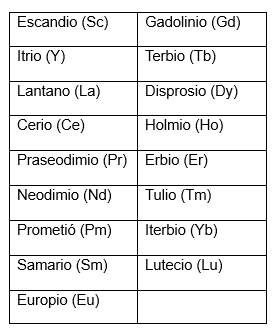
Algunos de los nombres de estos minerales se derivan de los nombres de los científicos que los descubrieron o establecieron sus propiedades, mientras que otros fueron nombrados por el lugar donde fueron descubiertos:

Geológicamente hablando, los elementos de tierras raras no son ni tierras ni particularmente raros. Los depósitos de estos metales se encuentran en muchos lugares en todo el mundo, con algunos de ellos en la misma abundancia en la corteza terrestre que el cobre o el estaño. Pero, al contrario de esos últimos, las tierras raras nunca se encuentran en concentraciones muy altas y generalmente se consiguen mezcladas entre sí o con elementos radiactivos, como el uranio y el torio, lo que hace compleja su manipulación y separación. Además, el proceso de separación de tierras raras entre sí es tecnológicamente complejo y costoso.

El mercado de metales de tierras raras se estimó en 5.300 millones de dólares en 2021 y se prevé que alcance los 9.600 millones de dólares en 2026; con un crecimiento anual del 12,3% de 2021 a 2026.

La producción de tierras raras involucra varios procesos complejos:

      • Se extraen de minas a cielo abierto o subterráneas, al igual que otros metales. Los principales países productores son China, Estados Unidos, Birmania y Australia.
      • El mineral se tritura y muele en polvo fino para liberar los elementos de tierras raras que contiene. Esto facilita su posterior separación.
      • Se usan técnicas como extracción con solventes o intercambio iónico para separar las tierras raras entre sí. Esto es complicado, ya que sus propiedades químicas son muy similares.
      • Una vez separados, se refinan mediante electrólisis o calcinación con ácidos, extrayendo los elementos individuales en forma de óxidos de alta pureza.
      • Los óxidos de tierras raras se pueden combinar con otros metales para producir aleaciones con propiedades deseadas, como imanes de neodimio-hierro-boro.
      • Las aleaciones y compuestos se manufacturan en productos finales como catalizadores, vidrio, cerámicas, imanes permanentes, baterías, entre otros.
      • También se reciclan productos que contienen tierras raras para reutilizar estos materiales.

Las propiedades magnéticas, fosforescentes y catalíticas, únicas de los REEs, los hacen insustituibles para muchas aplicaciones de alta tecnología. Por ejemplo, el neodimio se usa para fabricar imanes fuertes para motores y generadores en vehículos eléctricos, turbinas eólicas y otras aplicaciones de energía limpia. El europio se usa para fósforos rojos en televisores y monitores de computadora. El cerio se utiliza como catalizador en la refinación de petróleo.

Las tierras raras también son esenciales para las tecnologías de defensa, como los motores de aviones de combate, los sistemas de guía de misiles, los sistemas de comunicación y satélite, los sistemas de radar y sonar, y más. Por lo tanto, EE.UU., la UE, Japón y otros también consideran una prioridad de seguridad nacional asegurar cadenas de suministro confiables de tierras raras.

Es probable que los elementos de tierras raras sigan siendo una parte importante de nuestro futuro, desde la computación cuántica y las ciencias de los materiales hasta las aplicaciones médicas y los avances en tecnología ecológica. Los cambios en curso de los automóviles de combustión interna a los vehículos eléctricos también aumentarán la demanda de imanes y baterías de tierras raras.

En el contexto de transición energética, donde el sistema migra de seguridad de suministro de petróleo a seguridad de suministro de minerales, no solo de tierras raras, sino en mayor escala de cobre y el litio, entre otros, la geopolítica de las fuentes de suministro será también un factor importante para considerar, cuando de proyectar el despliegue de las nuevas tecnologías se trate.

Para satisfacer la demanda futura, las empresas mineras han propuesto abrir nuevas minas y construir nuevas plantas de procesamiento en muchas partes del mundo. En países que tendrán sus propios retos ambientales y sociales. Algunos planes suenan extravagantes, como la minería en aguas profundas o la extracción de tierras raras de las aguas residuales ácidas que se drenan de las minas abandonadas. Estas técnicas de producción podrían volverse económicamente viables si un gran aumento en la demanda hace subir los precios o si los gobiernos deciden subsidiar los costos de producción.

A diferencia de los precios del petróleo, el oro y la plata, los precios de los elementos de tierras raras son difíciles de conseguir, ya que no existe un intercambio público ampliamente utilizado para las tierras raras. Empresas como Argus Rare Earths publican evaluaciones de precios regulares basadas en encuestas de comerciantes, consumidores y otros participantes en el mercado.

Venezuela

Eventos Políticos y otros:El régimen, confrontado con un comportamiento inusualmente positivo de la oposición y el auge que ha alcanzado el interés de votar y aglutinarse alrededor de la candidatura de María Corina Machado, parece haber decidido eliminar cualquier vestigio de posibles elecciones justas y verificables, usando el Poder Legislativo y Judicial como instrumentos político-partidistas.

Ni las reuniones secretas en Catar entre los representantes de la administración Biden y representantes del régimen de Maduro, ni los esfuerzos de la Plataforma Unitaria Democrática (PUD) en Washington, han logrado destrabar las paralizadas negociaciones de México. Por el contrario, la administración de Biden está, aparentemente, endureciendo su tratamiento de las sanciones por la falta de colaboración del régimen. Esto al final redunda en la capacidad de recuperación la industria petrolera venezolana, que es lo que nos ocupa. Por el lado económico, la inflación continúa aumentando y la tasa de cambio rompió el techo de 30 bolívares/dólar.

Según fuentes cercanas al régimen, el Ministerio de Petróleo estaría por aumentar los precios del gas natural en el mercado doméstico, con el objeto de ir eliminando gradualmente los subsidios a los combustibles. El plan es el de triplicar los precios de este combustible a las empresas y fábricas que usan gas en sus hornos, calderas y calentadores; pagarán 3,3 dólares/MMBTU, un aumento importante versus el precio anterior de 1,13 dólar/MMBTU.

Sector Hidrocarburos

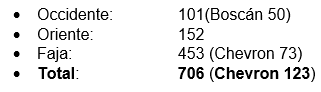
Producción: La producción semanal continúa afectada por el cierre de pozos producto de las explosiones en instalaciones en occidente y oriente. La producción semanal promedió 706 Mbpd distribuido geográficamente como sigue:

La producción de las empresas mixtas gestionadas por Chevron (NYSE: CVX) promediaron 123 Mbpd.

Refinación:El sistema nacional de refinerías procesó 225 Mbpd de crudo y productos intermedios. El Complejo Refinador Paraguaná (CRP), nuevamente tiene las dos unidades de craqueo catalítico (FCC) paradas, afectando la producción de gasolina; el reformador de Cardón también se encuentra en mantenimiento. La Refinería de Puerto la Cruz está en operación limitada por escasez de crudo liviano, y la Refinería El Palito está funcionando y produciendo unos 10 Mbpd de gasolina.

Exportaciones e importaciones:Como ya es costumbre, las exportaciones de principios de mes comienzan en niveles moderados y los despachos se espera se incrementen en la última quincena del mes. Las exportaciones de crudo apenas sobrepasan los 300 Mbpd, inclusive las manejadas por Chevron están rezagadas, pero con tanqueros atracados en los terminales o cerca de ellos. 

Durante el mes de junio se recibieron 2,1 MMbbls de condensado iraní, manteniendo así los inventarios de diluente a niveles normales. A finales del mes está programado recibir 500 Mbbls de nafta pesada traída por Chevron para diluir sus crudos de la Faja a segregaciones Merey y DCO. Por cierto, en los documentos de la aduana de EE.UU. se observa que un cargamento de crudo venezolano, exportado por Chevron fue vendido a ExxonMobil, siendo este la primera compra de crudo venezolano de esa empresa desde el impasse con la administración de Chávez.

—
(1)La agenda política de la OPEP+ es, por definición, extender en el tiempo la vida económica de los recursos que sus países miembros, extrayendo el mayor valor económico posible.
(2)Esta sección fue desarrollada con la ayuda de https://claude.ai/chats y contrastada con otras fuentes.
—
*La ilustración generada utilizando DALL-E, realizada por Luis A. Pacheco, es cortesía del autor al editor de La Gran Aldea.
—
*M. Juan Szabo, Analista Internacional.
*Luis A. Pacheco, non-resident fellow at the Baker Institute Center for Energy Studies.


Between One Thing and the Other - Publicado en Zignox, July 18, 2023

EL TALADRO AZUL - ZIGNOX


JUAN M. SZABO, LUIS A. PACHECO


In a world enduring long-lasting armed conflicts, as well as economic and technical barriers to deploy alternative energies, the replacement of fossil energy will not advance at the speed the IEA assumes in its most recent projection.


Several factors on the supply side have come together in recent days to give oil prices an upward push. Production interruptions in Libya, Nigeria, and Mexico, coupled with reinforced production cut commitments from Saudi Arabia and Russia, boosted prices to their highest levels in three months. In addition, the slowdown in US inflation seems to give, at least temporarily, an upper hand to the Federal Reserve's monetary tightening policy.


The oil supply has narrowed by more than 2.0 MMbpd, due to the apparent compliance with the production quota cuts announced by Saudi Arabia and Russia, which combined represent 1.5 MMbpd.


Additionally, in Libya, some 350 Mbpd of crude from some of the most productive fields, including El-Sharara, were shut for some days down last week. The rivalry between the factions, aggravated by protests by local tribes over the kidnapping of a former minister, disrupted the production, which later on was re-established.


In Nigeria, an alleged leak in the pipeline that connects to the loading buoy seems to have restricted the loading of tankers from the Forcados terminal, affecting some 300 Mbpd until the problem is solved.


On the other side of the world, the accident at Pemex’s operation in the Campeche Bank, caused a shutdown of some 700 Mbpd (almost half of Mexico's production). Output recovered somehow, but the last 150 MBPD, directly related to the gas compression that was destroyed by the fire on the Nohoch Alfa platform, will require more time and effort to be reactivated.


Meanwhile, the U.S. continues without contributing significant volumes to the composition of the supply. This week, the Baker Hughes report on drilling rigs showed a reduction of 5 net rigs; in the Permian Basin, the most attractive to reverse the stagnation, showed a reduction of 8 units. On the other side of the coin, , according to data from the same report, both Saudi Arabia and the United Arab Emirates (UAE) are incorporating drilling rigs.


On the demand side, mixed signals emerged, but the most relevant are the signs of economic lethargy coming from China; the main question being the government's ability to stimulate the economy. In any case, the month of July presents crude oil imports markedly lower than the high levels achieved in June. Part of the high import volumes went to swell the strategic reserves, which, unlike those of the US, are practically full.


Divergent views


Two of the most influential international organizations in the world of energy,  OPEC and the International Energy Agency, IEA, regularly publish their views on the oil industry. Their analyses rarely coincide: sometimes it seems that they are analyzing different commodities.


OPEC, for example, raised its oil demand growth forecast for 2023 and predicted only a slight slowdown in 2024. According to the analysis, despite economic headwinds, China and India continue to boost demand. In its monthly report, OPEC indicates that global oil demand will rise by 225 MMBPD in 2024, an increase of 2.2%, compared to a growth of 2.44 MMBPD in 2023. The analysis considers that the demographics, economic growth, and modest competition from viable energy alternatives will sustain the growing demand[1].


On the other hand, the IEA argues that oil demand is under pressure from the economic backdrop and its reaction to the drastic tightening of monetary policy in many advanced countries. Still, it forecasts global oil demand to increase seasonally by 1.6 MMbpd from Q2 to Q3 of this year, averaging 102.1 MMbpd for the full year, a record. Growth will slow to 1.1 MBPD in 2024, as the recovery loses momentum and increasing measures of electrification and vehicle fleet efficiency take hold.


These forecasts, while marginally different from OPEC's on energy and climate change, do point to declining demand, reflecting the IEA's political mandate to drive the energy transition as fast as possible.


A world with long-lasting armed conflicts, non-aligned interests between rich and poor countries, and economic and technical barriers in the deployment of alternative energy, among other variables, lead us to conclude that, for now, the replacement of fossil energy will not advance with the speed that the IEA assumes in its short-term analysis. OPEC's forecast, undoubtedly interesting, seems more likely for now.


In short, a potential economic recession, and the structural and accidental limitations in the supply of crude, position oil prices within a virtual band.


OPEC+ is determining a floor price, due to its ability to close and open production. The Saudis as swing producers.  On the other hand, the Chinese economy sets a price ceiling with its less-than-optimal economic performance, bolstered by its ability to use its strategic crude oil reserves to prevent prices from spiraling out of control.


In this range, the week showed a significant increase in prices from the previous week. Brent Crude was close to $82/bbl, but the news received from China caused massive sales of oil contracts. So, at the close of the market, prices fell back, trading at $79.87/bbl and $75.42 /bbl for Brent and WTI crudes respectively.


Finally, several important news is still developing, but their effect on the oil balance is unknown. Among the most relevant:


Russia increased the price of its Ural crude by more than $60/bbl, a move that was born out of the need for additional revenue. India, its second-best market, could veto the purchase of oil at those prices, for fear of being sanctioned. Local banks in India require proof that the price of shipping oil is below $60/bbl—please note that this is the ceiling imposed by the economic sanctions.


The heat wave in Europe is affecting the production of the Bugey and Saint Alban nuclear plants in France, due to environmental regulations on the use of river water for reactor cooling. Nuclear power generation in France constitutes about 70% of the country's electricity matrix, making France a net exporter of electricity to other European countries when its reactors are fully operational.


ExxonMobil (NYSE: XOM) has agreed to buy Denbury Inc. (NYSE: DEN) for $4.9B in stock. This acquisition seeks to accelerate the presence of the transnational in the field of energy transition, with an already established operation of Carbon Capture, Use, and Storage (CCUS: for its acronym in English). The acquisition, gives Exxon among other advantages, access to existing CO₂ transport capacity. Denbury also has an oil and gas production business.


California, the seventh-largest producer of crude oil in the US, has almost completely suspended the issuance of permits to drill new wells this year, according to state data. The state's Division of Geologic Energy Management, known as CalGEM, approved just seven new permits for 2023, compared to the more than 200 it had issued by this time last year. More than 1,400 requests have not been answered.


Shell (NYSE: SHEL) announced its fourth ultra-deep-water hydrocarbon discovery in Namibia, one of the most interesting offshore exploration provinces. The company, associated with France's TotalEnergies (NYSE: TOT) confirmed the presence of hydrocarbons in the Lesedi-1X well in ultra-deep waters off Namibia. Indications of the reservoir types discovered by Shell and Total suggest an oil province with characteristics similar to the discoveries in Guyana on the other side of the Atlantic.


Rare Earths


A few days ago, China announced that it will restrict the export of gallium and germanium, two minerals considered critical in the production of semiconductors, solar cells, and other systems associated with advanced electronics; on which much of modern life and the emerging energy transition depend.


According to what was announced by the Chinese Ministry of Commerce, these minerals and more than three dozen related metals and other materials will be subject to export controls from August 1, 2023. According to the Chinese government, the restrictions are motivated by security considerations and national interests, but it seems to be a deepening of the trade war that the eastern giant is carrying out with the US. The Americans had previously imposed restrictions on its gallium oxide exports in 2022 and other technologies associated with the manufacturing of computer chips.


This is not the first time that China has placed export restrictions on key materials in the electronics industry, in particular the so-called rare earth elements (REE), to secure their availability for its manufacturing and computer industries; and also, to underline its control over the global supply chain.


In the early 1990s, China began exporting REE after discovering large deposits in Inner Mongolia in the 1980s, and quickly became the largest global supplier. In 2005, China began to apply tariffs to the export of rare earths to conserve resources and protect the environment. Since then, the government has been implementing different measures to safeguard its dominant position in the rare earth market. According to the IEA, in 2019, China produced 87% of the rare earths and continues to be the heavyweight in the sector.


In February 2021, US President Joe Biden signed an executive order aimed at reviewing deficiencies in the country's supply chains for rare earths, medical devices, computer chips, and other critical resources. In March of the same year, the US Department of Energy announced an initiative to investigate and secure the national supply chains of rare earths and battery metals such as cobalt and lithium. In June 2022, Biden invoked the Defense Production Act to increase domestic production of critical minerals like rare earths, as well as fund feasibility studies and expand existing resources.


What are Rare Earths? [2]


Rare earths, also called rare earth elements or rare earth oxides, are a group of 17 metallic elements, located in the middle of the periodic table (atomic numbers 21, 39, and 57–71), in the lanthanide group . These metals have unusual fluorescent, conductive, and magnetic properties, making them very useful when alloyed or mixed in small amounts with more common metals, and are crucial materials in modern electronics.


Some names of these minerals are derived from the names of the scientists who discovered them or established their properties, while others were named after the place where they were discovered:


Scandium (Sc)

Yttrium (Y)

Lanthanum (La)

Cerium (Ce)

Praseodymium (Pr)

Neodymium (Nd)

Promised (Pm)

Samarium (Sm)

Europium (Eu)

Gadolinium (Gd)

Terbium (Tb)

Dysprosium (Dy)

Holmium (Ho)

Erbium (Er)

Thulium (Tm)

Ytterbium (Yb)

Lutetium (Lu)


Geologically speaking, the rare earth elements are not particularly rare. Deposits of these metals are found in many places around the world, with some of them in the same abundance in the earth's crust as copper or tin. But, contrary to the latter, rare earths are never found in very high concentrations and are generally found mixed with each other or with radioactive elements, such as uranium and thorium, which makes their handling and separation complex and expensive.


The global rare earth metals market generated USD7 billion in revenue in 2021, and it is expected to reach USD15 billion by 2030, progressing with a CAGR of 9.1% during 2021–2030.


The production of rare earths involves several complex processes:


They are extracted from open pit or underground mines, just like other metals. The main producing countries are China, the United States, Burma and Australia.

The ore is crushed and ground into a fine powder to release the rare earth elements it contains, facilitating their subsequent separation.


Techniques such as solvent extraction or ion exchange are used to separate the rare earths from each other. This is tricky since their chemical properties are very similar.

Once separated, they are refined by electrolysis or calcination with acids, extracting the individual elements in the form of oxides of high purity.


Rare earth oxides can be combined with other metals to produce alloys with desired properties, such as neodymium-iron-boron magnets. Alloys and compounds are manufactured into final products such as catalysts, glass, ceramics, permanent magnets, batteries, among others.


Products containing rare earths are also recycled to reuse these materials.

The unique magnetic, phosphorescent, and catalytic properties of REE make them irreplaceable for many high-tech applications. For example, neodymium is used to make strong magnets for motors and generators in electric vehicles, wind turbines, and other clean energy applications. Europium is used for red phosphors in televisions and computer monitors. Cerium is used as a catalyst in oil refining.


Rare earths are also essential for defense technologies such as fighter jet engines, missile guidance systems, satellite and communication systems, radar and sonar systems, and more. Therefore, the US, EU, Japan and others also consider it a national security priority to ensure reliable supply chains of rare earths.


Rare earth elements are likely to continue to be an important part of our future, from quantum computing and materials science to medical applications and advances in green technology. The ongoing shifts from internal combustion cars to electric vehicles will also increase demand for rare earth magnets and batteries.


In the context of the energy transition, where the system migrates from the security of oil supply to the security of mineral supply, not only for rare earths but on a larger scale for copper and lithium, among others, the geopolitics of supply will be a significant factor when planning the deployment of new technologies.


To meet future demand, mining companies have proposed opening new mines and building new processing plants in many parts of the world. In countries that will have their own environmental and social challenges. Some plans sound outlandish, like deep-sea mining or extracting rare earths from acidic wastewater that drains from abandoned mines. These production techniques could become economically viable if a large increase in demand drives up prices or if governments decide to subsidize production costs.


Unlike oil, gold, and silver prices, rare earth element prices are hard to come by as there is no widely used public exchange for rare earths. Companies like Argus Rare Earths publish regular price assessments based on surveys of dealers, consumers, and other market participants.


Venezuela: Political Events and More


The regime, confronted with an unusually coherent behavior of the political opposition, and the growing interest around the candidacy of María Corina Machado, seems to have decided to eliminate any vestige of possible fair and verifiable elections, using the legislative power and judicial as political-partisan instruments.


Neither the secret meetings in Qatar between representatives of the Biden administration and representatives of the Maduro regime, nor the efforts of the Democratic Unitary Platform (PUD) in Washington, have succeeded in unlocking the paralyzed negotiations in Mexico. By contrast, the Biden administration is apparently tightening its treatment of sanctions as a response to the regime's non-collaboration. This ultimately will impact in the recovery capacity of the Venezuelan oil industry, which is what concerns us in these reports.


On the economic side, inflation continues to rise, and the exchange rate broke the ceiling of Bs 30/$.


According to sources close to the regime, the Ministry of Petroleum is about to increase the prices of natural gas in the domestic market, to gradually eliminate fuel subsidies. The plan is to triple the prices of this fuel to the companies and factories that use natural gas in their ovens, boilers, and heaters; they will pay $3.3/MMBTU, a significant increase from today’s price of $1.13/MMBTU.


Hydrocarbons Sector.


Production: Weekly production continues to be affected by the closure of wells as a result of the explosions at facilities in the west and east. Weekly production averaged 706 Mbpd geographically distributed as follows:


West:                           101 (Boscán 50)

East:                            152

Belt:                             4 53 (Chevron 73)

Total:                           706 (Chevron 123)

Production from joint ventures managed by Chevron (NYSE: CVX) averaged 123 Mbpd


Refining: The national system of refineries processed 225 Mbpd of crude oil and intermediate products. The Paraguaná refining complex (CRP) once again has the two catalytic cracking units (FCC) stopped, impacting gasoline production; the Cardón reformer is also undergoing maintenance. The Puerto la Cruz refinery is in limited operation due to a shortage of light crude oil, and the El Palito refinery is operating and producing about 10 MBPD of gasoline.


Exports and Imports: As is customary, exports at the beginning of the month start at moderate levels, and shipments are expected to increase in the last fortnight of the month. Crude exports barely exceed 300 Mbpd, including those handled by Chevron are lagging, but with tankers docked at or near the terminals. 


During the month of June, 2.1 MMbbls of Iranian condensate were received, thus maintaining diluent inventories at normal levels. At the end of the month, it is scheduled to receive 500 Mbbls of heavy naphtha imported by Chevron to dilute its crudes from the Orinoco belt to Merey and DCO segregations. By the way, US customs documents show that a shipment of Venezuelan crude exported by Chevron was sold to ExxonMobil, this being the first purchase of Venezuelan crude from that company since the impasse with the Chávez administration.


______________________________________________


[1] OPEC+'s political agenda is, by definition, to extend the economic life of the resources of its member countries over time, extracting the greatest possible economic value.


[2]This section was developed with the help of https://claude.ai/chats and checked against other sources.


Note: A version of this article was published in Spanish by La Gran Aldea on July 18, 2023.


HORMUZ, FROM A STRAIT TO A TUNNEL

  El Taladro Azul M. Juan Szabo [1] y Luis A. Pacheco [2] Published  Originally in Spanish in    LA GRAN ALDEA       The energy market situa...