Tuesday, July 04, 2023

The Labyrinth of the Oil Market


Originally published in Spanish in La Gran Aldea  July 4, 2023

M. Juan Szabo [1]and Luis A. Pacheco[2]  


The oil market, always reactive to both good and bad news, seems to be navigating, in the face of the changing and often contradictory signals from the world economy, in a price labyrinth of complex resolution.

The dynamics of recent weeks continue to be repeated. Is it about supply or is it about demand? The market is torn between, on the one hand, what sometimes looks like a crusade by central banks to slow economic growth, and, on the other, a continued decline in global oil production capacity despite signs of a robust demand; a contest in which neither has a clear advantage.

But it turns out that the two trends are not independent of each other. The more interest rates are raised to limit economic growth and indirectly reduce the demand for oil, reflected in lower prices, the lower the levels of investment, undermining reaction capacity of the supply side, which should lead to higher prices.

In this confusing market, the slow recovery of the Chinese economy, which generates a lower demand for oil and pushes down oil prices, could somewhat slow down the aggressive monetary policy of the central banks – but is uncertain.

In the circular logic scenario in which we operate, the drop of 9.6 MMbbls in crude inventories, accompanied by an additional reduction in active rigs (-8) in the US, provided only a modest increase in oil prices.

To make the picture even more complex, the US, the world's largest economy, shows oil figures that hardly signal an impending recession:

·      US exports reached 5,338 MMbpd, up from 4,543 MMbpd last week and 3,572 MMbpd a year ago. This is a change of 17.50% from last week and 49.44% from a year ago.

·      US gasoline and distillate stocks fell 7% and 14% respectively, versus the 5-year seasonal average.

·      Total oil demand averaged 20.2 MMbpd, 1.3% more than in the same period last year; gasoline demand reached 9.4 MMbpd, 4% higher than last year.

·      Aviation fuel utilization increased 9.6% compared to the same period last year, global air travel is reaching all-time highs, poised to exceed pre-pandemic levels.

 A very “sui generis” “recession” without a doubt.


The oil supply will continue to be significantly reduced: in the US due to the reservoirs natural decline and lack of investment; in Saudi Arabia due to a voluntary cut that could be extended over time [3]; and Libya appears to be heading for a shutdown due to political turmoil. OPEC+ continues strangely silent in the face of what, for now, has been the failure of its production cut strategy.

At market close on Friday, London-traded Brent Crude was up 0.8% to $75.4/bbl for the week, a gain of 1.5% for the month; this year it has lost almost 6% of its value.

WTI crude, which is listed in New York, rose 1.4% on the week and 0.8% for the month;  this year it shows a loss of almost 3.5%.

In the natural gas market, prices, after skyrocketing to unexpected levels due to the Russian invasion of Ukraine and the sanctioning responses from Europe, have returned to their pre-invasion levels, close to $3/MMscf (million standard cubic feet).

This “normalization” results from the orderly replacement of a large part of the volumes of Russian natural gas, which practically monopolized the European market. The redistribution of supply sources: increased purchases of Liquefied Natural Gas (LNG), increased purchases of natural gas from Africa and the Middle East, a mild winter, diversification to nuclear, renewables and coal, have all managed to fill the vacuum created by the energy crisis in 2022. At the end of the day, the supply of Russian natural gas has fallen to a fifth of what it once was, mainly exported to China via the “Power of Siberia” pipeline . Russia has also had to maximize domestic consumption of natural gas, and free up exportable liquid hydrocarbons.

In this context, the news from Norway, sometimes the paradigm of an oil country leading the energy transition, start making sense. According to Reuters, the Norwegian government approved going ahead with the development of 19 oil and gas fields, with investments of more than 18.51 billion dollars, part of the country's strategy to extend production in the coming decades.

The Norwegian government, in response to criticism from environmentalists, says Norway's oil and gas resources are essential to Europe's energy security and will be needed for decades to come. An example of the difficult balance between decarbonization and the realities of the global energy system.

Finally, if we ask ourselves how is the energy transition progressing, some global numbers may shed light on the process:

·      The share of fossil fuels in global primary energy demand fell slightly from 82.3% in 2021 to 81.8% in 2022.

·      The share of renewables increased from 6.7% in 2021 to 7.4% in 2022, an increase concentrated in developed countries and China.


Energy transition

Why don't we freeze to death?

In 1824, Jean-Baptiste Joseph Fourier, a French mathematician and physicist, published a work entitled "Remarques generate them sur les températures du globe terrestrial et des espaces planetaires" . In that work, Fourier postulated that the Earth's atmosphere acted as a "veil" that trapped some solar heat. Thus, he gave the initial answer to the question of why the planet is not as cold as the surrounding space.

Fourier used experiments and mathematical calculations to show that the atmosphere was transparent to shortwave solar radiation, but opaque to long wave infrared radiation emitted by the Earth. This implied that a fraction of the heat absorbed by the planet did not return directly to space, but remained trapped in the atmosphere, generating an increase in global temperature. However, Fourier stopped short of proposing the source of this absorption.

It was John Tyndall (1820-1893), an Irish physicist, who experimentally identified this mechanism by determining the infrared radiation absorption properties of various gases (1829): nitrogen, oxygen, water vapor, carbon dioxide, ozone, and methane. Their main result was that the main gases in the atmosphere, oxygen (21%) and nitrogen (78%), had no significant absorption, while water vapor was the strongest absorber and emitter of infrared radiation.

The seasoned reader will realize that neither CO₂ nor methane played a significant role in Tyndall's model, which attributed the greatest warming effect to water vapor. Although small amounts of hydrocarbons and CO₂ could have a significant effect, it would be other authors who would later expand these investigations [4].

Methane

Although it is CO₂ that monopolizes most of the news on climate change and potential global warming, in this installment we will highlight the role of its co-star, methane.

Methane is a colorless and odorless gas, which is made up of one carbon atom and four hydrogen atoms (CH 4 ), it is the simplest hydrocarbon and is the majority component of natural gas. Methane is highly flammable and is found in various natural sources and human activities.

In nature, methane is produced through biological and geological processes. Natural sources include wetlands, swamps, termite mounds, the digestive system of ruminant animals, and the decomposition of organic matter under anaerobic conditions , among others.

In addition to natural sources, methane is emitted through human activities. Major methane contributors are the fossil fuel industry , agriculture (especially cattle ranching and rice cultivation), waste management (landfill and wastewater treatment), and biomass burning.

The emissions and therefore the concentration of methane in the atmosphere are much lower (1/200 of those of CO₂) and it has a shorter life than CO₂ (around 12 years). However, due to the peculiarities of how its molecule interacts with infrared radiation, it absorbs much more energy while in the atmosphere: over a 20-year period, methane absorbs more than 80 times the energy of a comparable volume of CO₂. 

Over 100 years, each additional molecule of methane in the atmosphere is 30 times more powerful in warming than one molecule of CO₂. So even though methane emissions are only 0.8% of CO₂ emissions, they have a disproportionate influence on warming.[5]

Turkmenistan case

The International Energy Agency (IEA) estimates that the oil and gas sector emitted around 70 MMt of methane (approximately 2.1 Gt CO₂-eq ) in 2020, just over 5% of global energy-related greenhouse gas emissions [6].

Although the proportion seems small, its impact is important, as explained above. Therefore, any effort to reduce these emissions is not only welcome as part of the operational responsibility of oil and gas companies, but is an economically attractive proposition.

According to the IEA, while the oil & gas industry can and should continue to work in this direction, government standards and regulations will be crucial in removing or mitigating the obstacles that prevent companies from getting started and going further. They identify three types of obstacles that deter companies from taking full advantage of these opportunities: information, infrastructure, and investment incentives.

As an example, Bloomberg Green reported the meetings of technicians from the US and Turkmenistan, to implement reductions of what can be considered some of the worst methane emissions in the world.

Bloomberg estimates that, if all the gas that leaks or vents in Turkmenistan is recovered or flared, and the European Union's standards for coal mine emissions come into effect, it would have a climate effect equivalent to removing approximately 290 MMTm/year of CO₂.

According to the calculations of the group of experts in energy Ember and the Bloomberg agency, this action is equivalent to eliminating the emissions of Taiwan, the main manufacturer of chips in the world and the twenty-first polluter globally.

Similar projects should be implemented in countries with a high degree of methane emissions, such as: China, Russia, Mexico and Venezuela. The IEA has published a report and roadmap to work on the reduction of these emissions in oil and gas production operations , also for the extraction of coal .

Although the fossil fuel sector can and should continue to work in this direction, government rules and regulations will be crucial to remove or mitigate the obstacles that prevent companies from moving forward with these high-impact projects. 

Venezuela

Politics

Probably the event with the greatest repercussion in the country and internationally is the disqualification from holding public office of Mrs. María Corina Machado (MCM), which officiously announced by the Comptroller General of the Republic. Mrs. Machado clearly leads the opinion polls for the primary elections that will choose the Venezuelan opposition candidate for the 2024 presidential elections.

These new signals from the Maduro regime could put pressure on the Biden administration to consider suspending current licenses under the sanctions regime; in particular, the GL41 granted to Chevron. A measure of that nature would withdraw more than $100 million per month of income, that is, 25% of the currencies that barely keep the deterioration of the Bolívar and the acceleration of inflation under control.

Additionally, of economic and political relevance, the Court of Appeals of the United Kingdom, dismissed the allegations presented by Central Bank of Venezuela, related to the control of the gold deposited in the Bank of England vaults. The court ruling is based on the doctrine of "one voice": at the time the first instance decision was published, England recognized Juan Guaidó as interim president of Venezuela.

On the other hand, in the US, PDV Holding, CITGO's parent company, finally managed to get Rosneft , the Russian oil company, to hand over the certificate of 49.9% of CITGO shares it had in its possession. The shares were pledged to the Russian company, in 2016, as collateral for an advance payment agreement of 1.5 billion dollars; an operation that the Venezuelan opposition considered illegal at the time.

Hydrocarbons Sector.

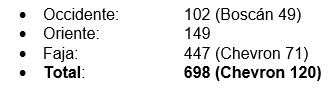
Production: This last week , crude oil production has suffered a decline due to the explosion in El Tejero (in the eastern region of the country). Weekly production averaged 698 Mbpd, geographically distributed as follows:

·      West:               102 (Boscán 49)

·      East:                149

·      Belt:                 447 (Chevron 71)

·      Total:               698 (Chevron 120)

·       

A reduction of 13 Mbpd of light crude in the North of Monagas, partially offset by an increase of 3 Mbpd in the Franquera Field on the Eastern Shore of Lake Maracaibo.

Production from Chevron's joint ventures averaged 120 Mbpd, in line with the maintenance and reconditioning efforts they have been deploying.

Refining: 210 Mbpd of crude oil and intermediate products were processed in national refineries, reporting a lower level in the Puerto la Cruz refinery due to the deduction of the availability of light crude oil. The El Palito refinery continues trying to stabilize its processes, even though PDVSA announced that the refinery covers a fifth of the national demand is covered. As of last week, the Paraguaná refining complex, is delivering a mixture of naphtha and reformate that is being sold at local service stations, and a little more diesel, probably due to the start-up of a distillation unit in Amuay.

The gasoline shortage has not changed, hours and sometimes days in long queues are required to refuel throughout the national territory, except in Caracas and to a lesser extent in Valencia.

Exports: Crude exports from Venezuelan terminals have followed the usual pattern of closing the month with an increase: The monthly average increased to 530 Mbpd of crude: 34 Mbpd to Cuba, 30 Mbpd to Europe, 136 Mbpd to the US. , exported by Chevron, and 330 Mbpd to Asia with final destination China.

Information from China explains the accumulation of inventories and the difficulty of placing sanctioned Venezuelan and Iranian crude oil in the Chinese market. Customs in Shandong, a coastal province in China, began to release the millions of barrels of oil from Venezuela and Iran that were being held at ports due to inspections that halted imports.

The restriction began with cargoes renamed “Bitumen Blend” and handled through Malaysia to evade sanctions and quotas from Shandong's private refiners. Chinese customs will issue new specifications that these blends have to meet. Almost all of these shipments are of Venezuelan origin, including those that appear on paper to come from Iran.

Finally, the Russian state-owned company, Roszarubezhneft, is requesting from PDVSA a similar treatment to the one agreed with Chevron, to recover debt from PDVSA. It is about $3.5 MMM corresponding to PDVSA's debts with the MS, and an additional $1.5 MMM for a loan that is not being repaid. The five JV's where Roszarubezhneft participates produce around 70 Mbpd as a whole, of which the only one of any size is PetroMonagas.


[1] International Energy Analyst

[2]Nonresident Fellow Baker Institute

[3] At the close, Saudi Arabia announced the extension of the cut until August.

[4]This basic summary is based on the book The Physics of Climate Change , Lawrence M. Krauss, Post Hill Press , 2021

[5] Unsettled : What Climate Science Tells Us, What It Doesn't, and Why It Matters . Steven E. Koonin . 2021

[6]https://www.iea.org/reports/driving-down-methane-leaks-from-the-oil-and-gas-industry 


El Mercado en su Laberinto

EL TALADRO AZUL

M. JUAN SZABO / LUIS A. PACHECO |

Publicado en La Gran Aldea. Julio 4, 2023

El mercado petrolero siempre reactivo, tanto a las buenas como a las malas noticias, pareciera estar transitando, ante las cambiantes y muchas veces contradictorias señales de la economía mundial, en un laberinto de precios de compleja resolución. Se sigue repitiendo la dinámica de las últimas semanas. ¿Se trata de la oferta o se trata de la demanda? El mercado se debate entre, por un lado lo que a veces luce como una cruzada de los bancos centrales para ralentizar el crecimiento económico; y, por el otro, una continua declinación de la capacidad global de producción de crudo a pesar de que hay señales de una demanda robusta; una contienda en la que ninguna de las partes tiene una clara ventaja.

Pero resulta que las dos tendencias no son independientes entre sí. Cuanto más se suban las tasas de interés para limitar el crecimiento económico e indirectamente reducir la demanda de petróleo, reflejada en precios más bajos, menores serán los niveles de inversión, socavando la capacidad de reacción del lado de la oferta, lo que debería conducir a precios más altos.

En esta confusa lógica de mercado la lenta recuperación de la economía China, que genera una menor demanda petrolera y presiona a la baja los precios del petróleo, pudiera frenar en algo la agresiva política monetaria de los bancos centrales. En el escenario de lógica circular en el que nos desenvolvemos, la caída de 9,6 MMbbls en los inventarios de crudo, acompañado de una reducción adicional de taladros activos (-8) en EE.UU., proporcionó apenas un incremento modesto de los precios petroleros.

Para hacer el panorama aún más complejo, EE.UU., la economía más grande a nivel mundial, muestra cifras petroleras que difícilmente señalan una inminente recesión:

      • Las exportaciones de EE.UU. alcanzaron 5,338 MMbpd, por encima de los 4,543 MMbpd de la semana pasada y de los 3,572 MMbpd de hace un año. Este es un cambio de 17,50% desde la semana pasada y 49,44 % desde hace un año.
      • Las existencias de gasolina y destilados de EE.UU. cayeron 7% y 14% frente al promedio estacional de 5 años.
      • La demanda total de petróleo promedió 20,2 MMbpd, 1,3% más que en el mismo período del año pasado; solamente la demanda de gasolina llegó a 9,4 MMbpd, 4% superior al año pasado.
      • La utilización de combustible de aviación aumentó un 9,6% en comparación con el mismo período del año pasado, los viajes aéreos en el mundo están alcanzando los máximos históricos, a punto de superar los niveles prepandemia.

Una “recesión” muy sui géneris sin duda.

El suministro de crudo seguirá reduciéndose significativamente: en Estados Unidos por declinación de los yacimientos y falta de inversión; en Arabia Saudita por un recorte voluntario que podría prolongarse en el tiempo1; y Libia parece estar encaminándose a un cierre masivo por agitación política. La OPEP+ continúa con su extraño silencio ante lo que, por ahora, ha sido el fracaso de su estrategia de recortes de producción.

Al cierre del mercado el viernes, el crudo Brent, negociado en Londres, subió un 0,8%, a 75,4 $/bbl en la semana, una ganancia del 1,5% en el mes; en lo que va de año ha perdido casi 6% de su valor. El crudo WTI, que cotiza en Nueva York, subió un 1,4% en la semana y un 0,8% en el mes. Pero en lo que va de año muestra una pérdida de casi 3,5%. En el mercado del gas natural los precios, luego de dispararse a niveles inesperados por la invasión rusa a Ucrania y las respuestas sancionatorias de Europa, han vuelto a sus niveles de pre-invasión, cercano a los 3 $/MMpc (millones de pies cúbicos).

Esta “normalización” resulta de la sustitución ordenada de buena parte de los volúmenes de gas natural ruso, que prácticamente monopolizaba el mercado europeo. La redistribución de las fuentes de suministro: mayores compras de gas natural licuado (LNG: por sus siglas en inglés), mayores compras de gas natural de África y Medio Oriente, un invierno suave, diversificación a nuclear, renovables y carbón, han logrado llenar el vacío que creó la crisis energética en el 2022. Al final del día, el suministro de gas natural ruso ha caído a una quinta parte de lo que fuese, principalmente exportado a China a través del gasoducto “Poder de Siberia”. Rusia también ha tenido que maximizar el consumo interno de gas natural, y liberar hidrocarburos líquidos exportables.

En este contexto, las noticias desde Noruega, a veces paradigma de país petrolero liderando la transición energética, hacen mucho sentido. Según Reuters, el gobierno noruego aprobó seguir adelante con el desarrollo 19 campos de petróleo y gas, con inversiones superiores a los 18.510 millones de dólares, parte de la estrategia del país para extender la producción en las próximas décadas.

El gobierno Noruego, en respuesta a las críticas desde el sector ambientalista a estas decisiones, dice que los recursos de petróleo y gas de Noruega son esenciales para la seguridad energética de Europa y serán necesarios en las próximas décadas. Un ejemplo del difícil balance entre la descarbonización y las realidades del sistema energético mundial.

Finalmente, si nos preguntamos cómo sigue avanzando la transición energética, algunos números globales arrojan luces sobre el proceso:

      • La participación de los combustibles fósiles en la demanda mundial de energía primaria cayó ligeramente de 82,3% en 2021 a 81,8% en el 2022.
      • La participación de las energías renovables aumentó de 6,7% en 2021 a 7,4% en 2022, un aumento concentrado en los países desarrollados y China.

Transición Energética

¿Por qué no nos morimos de frío? En 1824, Jean-Baptiste Joseph Fourier, un matemático y físico francés, de recuerdo ingrato para todos los que han estudiado cálculo avanzado, publicó un trabajo titulado “Remarques générales sur les températures du globe terrestre et des espaces planétaires” (Investigaciones sobre las temperaturas del globo terrestre y los espacios planetarios). En ese trabajo, Fourier postuló que la atmósfera de la Tierra actuaba como un “velo” que atrapaba parte del calor solar. Así le daba respuesta inicial a la pregunta de por qué el planeta no es tan frío como el espacio alrededor de él.

Fourier utilizó experimentos y cálculos matemáticos para demostrar que la atmósfera era transparente a la radiación solar de onda corta, pero opaca a la radiación infrarroja de onda larga emitida por la Tierra. Esto implicaba que una fracción del calor absorbido por el planeta no retornaba directamente al espacio, sino que se mantenía atrapado en la atmósfera, generando un aumento de temperatura global. Sin embargo, Fourier no llegó a proponer cuál era la fuente de esa absorción.

Fue John Tyndall (1820-1893), físico irlandés, quién identifico por vía experimental ese mecanismo al determinar las propiedades de absorción de radiación infrarroja de varios gases (1829): nitrógeno, oxígeno, vapor de agua, dióxido de carbono, ozono y metano. Su principal resultado fue que los principales gases de la atmósfera, el oxígeno (21%) y el nitrógeno (78%), no tenían una absorción significativa, mientras que el vapor de agua era el responsable de absorber y el emisor más fuerte de radiación infrarroja.

El lector avezado se dará cuenta de que ni el CO₂ ni el metano jugaban un rol importante en el modelo de Tyndall, que atribuía al vapor de agua el mayor efecto de calentamiento. Aunque pequeñas cantidades de hidrocarburos y CO₂ pudieran tener un efecto significativo, serían otros autores los que posteriormente ampliarían estas investigaciones2.

El Metano

Aunque es el CO₂ el que acapara la mayoría de las noticias sobre el cambio climático y el potencial calentamiento global, resaltáremos en esta entrega el rol de su coprotagonista, el metano.

El metano es un gas incoloro e inodoro, que se compone de un átomo de carbono y cuatro átomos de hidrógeno (CH4), es el hidrocarburo más simple y es el componente mayoritario del gas natural. El metano es altamente inflamable y se encuentra en diversas fuentes naturales y actividades humanas. En la naturaleza el metano se produce a través de procesos biológicos y geológicos. Las fuentes naturales incluyen humedales, pantanos, termiteros, el sistema digestivo de animales rumiantes y la descomposición de materia orgánica en condiciones anaeróbicas, entre otros.

Además de las fuentes naturales, el metano se emite a través de actividades humanas. Los principales contribuyentes de metano son la industria de los combustibles fósiles, la agricultura (especialmente la cría de ganado y el cultivo de arroz), la gestión de residuos (vertederos y tratamiento de aguas residuales) y la quema de biomasa.

Las emisiones y por ende la concentración del metano en la atmósfera son mucho menores (1/200 de las de CO₂) y tienen una vida menor que el CO₂ (alrededor de 12 años). Sin embargo, debido a las peculiaridades de cómo su molécula interactúa con la radiación infrarroja, absorbe mucha más energía mientras permanece en la atmósfera: durante un período de 20 años el metano absorbe más de 80 veces la energía de un volumen comparable de CO₂.

En un lapso de 100 años, cada molécula adicional de metano en la atmósfera es 30 veces más potente en calentamiento que una molécula de CO₂. Por eso, aunque las emisiones de metano son solo 0,8% de las emisiones de CO₂, ellas tienen una influencia desproporcionada en el calentamiento3.

Caso Turkmenistán

La Agencia Internacional de la Energía (IEA, por sus siglas en inglés) estima que el sector del petróleo y el gas emitió alrededor de 70 MMt de metano (aproximadamente 2,1 Gt CO₂-eq) en 2020, poco más del 5% de las emisiones mundiales de gases de efecto invernadero relacionadas con la energía4.

Aunque la proporción luce pequeña, como explicamos, su impacto es importante. Por ello, cualquier esfuerzo en el sentido de reducir esas emisiones no solo es bienvenido como parte de la responsabilidad operativa de las compañías de petróleo y gas, sino que es una proposición económicamente atractiva.

Según la IEA, aunque el sector de hidrocarburos puede y debe continuar trabajando en este sentido, las normas y regulaciones gubernamentales serán cruciales para eliminar o mitigar los obstáculos que impiden a las empresas adelantar proyectos e ir más allá. Identifican tres tipos de obstáculos que disuaden a las empresas de aprovechar por completo estas oportunidades: información, infraestructura e incentivos a la inversión.

Como ejemplo, Bloomberg Green reportó las reuniones de técnicos de EE.UU. y Turkmenistán, para instrumentar reducciones de lo que se puede considerar como una de las peores emisiones de metano del mundo; resultado de la operación de viejas instalaciones de producción petróleo y gas.

Si todo el gas que se filtra o ventea en el sector energético de Turkmenistán, se recupera o se quema, y las normas de la Unión Europea para las emisiones de minas de carbón entrarán en vigor, las medidas combinadas tendrían un efecto climático equivalente a eliminar aproximadamente 290 MMTm/año de CO₂. Según los cálculos del grupo de expertos en energía Ember y la agencia Bloomberg esta acción equivale a eliminar las emisiones de Taiwán, el principal fabricante de chips del mundo y el vigésimo primer contaminador a nivel global.

Proyectos similares deben implementarse en países con alto grado de emisiones de metano, como: China, Rusia, México y Venezuela. La IEA ha publicado un reporte y hoja de ruta para trabajar en la reducción de esas emisiones en las operaciones de producción de petróleo y gas, también para la extracción de carbón.

Aunque el sector de combustibles fósiles puede y debe continuar trabajando en este sentido, las normas y regulaciones gubernamentales serán cruciales para eliminar o mitigar los obstáculos que impiden a las empresas adelantar estos proyectos de alto impacto.

Venezuela

Eventos Políticos:El hecho de mayor repercusión política en el país y a nivel internacional, es la inhabilitación para el ejercicio de cargos públicos de María Corina Machado (MCM) anunciada oficiosamente por la Contraloría General de la República. La señora Machado lidera claramente las encuestas de opinión para las elecciones primarias que elegirán al candidato de la oposición venezolana para las elecciones presidenciales de 2024.

Estas nuevas señales desde el régimen de Maduro podrían presionar a la administración Biden para suspender las licencias vigentes bajo el régimen de sanciones, en particular la GL41 otorgada a Chevron. Una medida de esa naturaleza retiraría más de 100 MM$ mensuales de ingresos en divisas, o lo que es decir, 25% de las divisas que apenas mantienen frenado el deterioro del bolívar y la aceleración de la inflación.

Adicionalmente, de relevancia económica y política, el Juzgado de Apelaciones del Reino Unido desestimó los alegatos presentados por el Banco Central de Venezuela, relacionados con el control del oro depositado en las bóvedas bancarias inglesas. La sentencia judicial se basa en la doctrina de “una sola voz”: en el momento de publicarse la decisión en primera instancia, Inglaterra reconocía a Juan Guaidó como presidente interino de Venezuela.

Por otro lado, en los EE.UU., PDV Holding, empresa matriz de CITGO, logró finalmente que Rosneft, la empresa petrolera rusa, entregará de vuelta el certificado del 49,9% de las acciones de CITGO que tenía en su poder. Las acciones se comprometieron con la empresa rusa, en 2016, como garantía de un acuerdo de pago anticipado de 1.500 millones de dólares; una operación que la oposición venezolana consideró en su momento ilegal.

Sector Hidrocarburos

Producción:Esta última semanala producción de crudo ha sufrido un retroceso a causa de la explosión en El Tejero (en la región oriental del país). La producción semanal promedió 698 Mbpd, distribuido geográficamente como sigue:

Una reducción de 13 Mbpd de crudo liviano en el norte de Monagas, compensado parcialmente por un incremento de 3 Mbpd en el Campo Franquera en la Costa Oriental del Lago de Maracaibo. La producción de las empresas mixtas de Chevron promedió 120 Mbpd, en línea con los esfuerzos de mantenimiento y reacondicionamiento que han venido desplegando.

Refinación:Se procesaron 210 Mbpd de crudo y productos intermedios ​​en las refinerías nacionales, reportándose menor nivel en la Refinería de Puerto la Cruz por deducción de la disponibilidad de crudo liviano. La Refinería El Palito continúa intentando estabilizar sus procesos, a pesar de que PDVSA anunció que, desde esa refinería, se cubre una quinta parte de la demanda nacional. Mientras tanto, el Complejo Refinador Paraguaná, al igual que la semana pasada, está entregando al mercado nacional una mezcla de nafta y reformado que se está expendiendo en las estaciones de servicio, y algo más de diésel, probablemente por el arranque de una unidad de destilación en Amuay. 

La escasez de gasolina no ha variado, se requieren horas y a veces días para repostar en todo el territorio nacional, excepto en Caracas y en menor grado en Valencia.

Exportaciones: La exportación de crudo desde los terminales venezolanos ha seguido el patrón acostumbrado de cerrar el mes con un incremento: El promedio mensual incrementó a 530 Mbpd de crudo: 34 Mbpd a Cuba, 30 Mbpd a Europa, 136 Mbpd a EE.UU., exportado por Chevron, y 330 Mbpd a Asia con destino final China.

Una información llegada desde China explica la acumulación de inventarios y la dificultad de colocar crudos sancionados, venezolanos e iraníes, en el mercado Chino. La aduana de Shandong, provincia costera en China, comenzó a liberar los millones de barriles de petróleo de Venezuela e Irán que estaban retenidos en los puertos por las inspecciones que frenaron las importaciones.

La restricción comenzó con los cargamentos rebautizados como “Bitumen Blend” y manejados a través de Malasia para evadir las sanciones y las cuotas de las refinerías privadas de Shandong. La aduana china emitirá nuevas especificaciones que estas mezclas tienen que cumplir. Casi la totalidad de estos cargamentos son de origen venezolano, inclusive los que en papel parecen venir de Irán.

Finalmente, la empresa estatal rusa, Roszarubezhneft, a quien le fueron transferidas por Rosneft todas las participaciones en empresas mixtas (EM) en Venezuela, está solicitando de PDVSA un trato similar al acordado con Chevron, para así recuperar los dineros que PDVSA le adeuda. Se trata de unos 3,5 MMM$ correspondiente a deudas de PDVSA con las EM, y 1,5 MMM$ adicional por un préstamo que no está siendo amortizado. Las 5 EM donde Roszarubezhneft participa producen alrededor de 70 Mbpd en su conjunto, de las cuales la única de cierta envergadura es PetroMonagas.

—
(1)Al cierre, Arabia Saudita anunció la extensión del recorte hasta el mes de agosto.
(2)Este resumen está basado en el libro The Physics of Climate Change, Lawrence M. Krauss, Post Hill Press, 2021.
(3)Unsettled: What Climate Science Tells Us, What It Doesn’t, and Why It Matters. Steven E. Koonin. 2021
(4)Unsettled: What Climate Science Tells Us, What It Doesn’t, and Why It Matters. Steven E. Koonin. 2021.

—
*La ilustración generada utilizando Midjourney, realizada por Luis A. Pacheco, es cortesía del autor al editor de La Gran Aldea.

—
*M. Juan Szabo, Analista Internacional.
*Luis A. Pacheco, non-resident fellow at the Baker Institute Center for Energy Studies.


Tuesday, June 27, 2023

Barrels and Central Banks

 EL TALADRO AZUL


Published in Zignox. June 27, 2023


Despite expectations of a potential recession induced by rising interest rates, the oil global demand continues to track at 101 MMbpd with no signs of slowing down anytime soon. How a still hawkish monetary policy will affect the global energy balance?


Juan M. Szabo and Luis A. Pacheco 


China's economic recovery has fallen short of expectations, and the less rosy reality is tempering the oil markets' initial excitement about better prospects. And while the eastern giant's industrial recovery has not been up to par, with consumer-oriented sectors underperforming, the decision by the People's Bank of China to cut two benchmark interest rates by just 10 basis points each, is considered too small to make a difference. Therefore, the topsy-turvy reaction among market players was undoubtedly a foregone conclusion. 

On the other side of the world, the story is somewhat different, although the impact on the market has been the same. The Bank of England surprised many by raising interest rates from 4.5% to 5%, stoking fears of a recession in the Old Continent. This was not a solo increase, as the European Central Bank had announced a 0.25% hike, and central banks in Norway and Switzerland raised interest rates on the same day as the BOE. Also, the Federal Reserve in the US warned that two additional increases can be expected for the remainder of 2023. The central banks' strategy, and their consequential macroeconomic projections, have undermined confidence in the oil demand outlook, pushing prices down.

We face an oil anomaly. In one part, the perception that the oil market is in a “bearish mode” amid the expectation of a potential recession --that eventually the central banks will turn into an extended one-- as a way to subdue inflation. On the other hand, the market observes that for now and for the foreseeable future, world crude oil inventories are low and decreasing, a situation that could become critical if we consider that current consumption is at historical highs. These two sides of the market, negative sentiment and critical inventories, are engulfing the oil market in what some call “cognitive dissonance”. 

Global Supply

Non-OPEC+ supplies continue without showing signs of improvement. The US, the largest oil producer, continues to lose ground by experiencing a further reduction in active rigs, with -6 this week or 71 less than 12 months ago. The second-largest producer, Brazil, is plateauing at 3.2 MMbpd, with a decline that it will not be able to offset until the newly added rigs start supplying additional output potential, estimated for the end of the first quarter of 2024.

On the OPEC+ side, the only foreseeable change is the cut of 1.0 MMBPD announced by Saudi Arabia for July, the effect of which could be neutralized with the floating inventories they maintain on the coast of Egypt. So, there are no major-scheduled changes, although the beginning of the hurricane season in the Gulf of Mexico, as well as the unexpected events in Russia, could generate temporary interruptions in oil production. 

An analysis of drilling activity reveals that the few countries that show an increase in activity are more than offset by declines in other regions: The net result is a reduction of 18 rigs year to date.

Closer to the Latin American region, Ecuador will soon vote on legislation to ban production at one of its main oil blocks. According to public polls, the proposed bill has a high possibility of being approved in August. The issue concerns block 43-ITT in the Amazon region of Yasuní, which includes the Ishpingo, Tambococha and Tiputini (ITT) fields, where the state-owned oil company, Petroecuador, began operations in 2016. If the legislative initiative is approved, Ecuador would reduce its production by some 60 Mbpd, a reduction in oil revenue of more than USD1 billion/year. 

The completion of the gas pipeline to transport Vaca Muerta gas from southern to northern Argentina could put a few additional barrels of oil on the market, as a good portion of the gas to be transported is associated with oil. However, as is often the case in state-run activities, now that there is an infrastructure in place, there are no wells.

Global demand

The global demand continues to hover at 101 MMbpd and has not shown the signs of reduction that one would expect given the expectation of a recession induced by interest rate hikes: the market has been slow to digest or believe these signals. 

Although China has maintained its pace of crude imports, it seems that part of these volumes is being stored in its strategic reserve, as the internal demand for fuels is below estimates.

The Netherlands, after much discussion, has announced the upcoming October 1 as the final closure date for Europe's largest gas field, Groningen. The replacement of this gas in Europe will come from greater imports of LNG and from the increase in demand for crude oil.

The demand for aviation fuel, like the demand for oil for its transformation into petrochemical products, remains strong and with a tendency to grow, both in Asia and North America. 

The Basics: Demand/Supply Equation

From all of the above, we can infer that, for now, prices will remain volatile, reacting to a kind of "ping-pong" between the reality of the physical market and the emotion induced by emerging news. 

During the week, Brent and WTI prices reached lows of USD72/bbl and USD68/bbl, respectively, but on Friday prices experienced a recovery of USD2/bbl and USD1.5/bbl for Brent and WTI respectively.

Finally, although the political-military crisis in Russia quickly deflated, the situation could still lead to instability that infects the markets in general and the energy market in particular. Let's not forget that Russia's oil and gas production is a cornerstone of the global energy system. 

Venezuela, Politics, and Economy

The situations and events this week that have the greatest repercussion in the political/economic field that could have an impact on the future of the hydrocarbons industry are:

• The Maduro regime continues to refuse to return to negotiations with the opposition, in Mexico.
• The resignation of all members of the National Electoral Council (CNE), under pressure from the Venezuelan regime, further weakens the legitimacy of any electoral process going forward. 
• Roger Carstens, the US special envoy for hostage affairs, once again visited Venezuela. Their presence, and other recent visits by major Venezuelan debt holders, could indicate that there are talks between the US administration and the regime in Venezuela to lift the sanction that prevents the transactions of sovereign debt and PDVSA bonds, in exchange for the release of some political prisoners.
• The Central Bank of Venezuela (BCV) confirmed that, during the first 5 months of 2023, inflation has reached 100%.
• During the month of June, the bolivar has already lost 5% of its value in the parallel market, fueling inflation and the deterioration of the purchasing power of the population.

Hydrocarbons

Production: During the last months, crude oil production has stabilized, affected only by power outages, including the explosion of a PDVSA substation in Bachaquero, in western Venezuela, which affected some fields on the eastern shore of Lake Maracaibo: Barúa, Motatán, and Franchise. 

An explosion was also reported in the eastern region, at the Tejero Operations Center (COT), in Punta de Mata, where both light crude oil and gas are processed and compressed; the production could be negatively affected and in addition to an increase in venting and gas flaring. Downstream, processing could also be reduced or stopped altogether at the Puerto la Cruz refinery; also, the capacity to blend Merey 16 crude could also be affected. Information has been too scant to fully assess the damage and its consequences. 

In sum, the average production for June seems to be 710 Mbpd. The geographical distribution of production, showing Chevron's contribution in parentheses, is presented in the following table in thousands of barrels per day (Mbpd):
•      West                             100 (48 Boscán)
•      East /South                 162 (could change depending on the accident)
•      Orinoco Belt:              448 (70 PetroPiar and PetroIndependencia)
•      TOTAL:                        710 (Chevron 119)

The production of the joint ventures (JVs) operated by Chevron has reached as high as could be expected, considering that investments are not allowed under the OFAC General License (GL41 ) currently in force. The expected extension of the license has not occurred due to the suspension of the negotiation process in Mexico. Production in the West shows a certain upturn with the activation of wells in the Franquera Field.

Active drilling rigs in the country increased to 2, both operating for PetroMonagas in the Orinoco Belt. They are drilling and casing surface wells in tandem. People close to the operations report that both units are in poor mechanical condition, operating only 20% of the time.

Chevron 

A more detailed analysis of the levels of production in Venezuela recently, with an emphasis on the last eight months, just before the General License 41 was granted, allows us to conclude that the main element in the growth of production during the period, has been the management of production in Campo Boscán, in addition to the efforts of the multinational oil company to reduce deferred production in PetroPiar and PetroIndependencia, in the Orinoco Belt.


As can be seen in the graph, during the first 9 months of 2022, Campo Boscán produced variable volumes, between 25 and 55 Mbpd, mainly subject to fluctuations in the asphalt market in the Far East, where the production was going. During the negotiations of the terms of GL41, the field was closed and returned to production once the License was issued by OFAC, reaching a production close to 50 MBPD, equal to its production before the “strategic” closure.  


Chevron’s joint ventures in the Orinoco Belt received a different treatment. The decrease in production before 2023 was slight and a result of reduced maintenance activity, possibly to keep the upgrader at Jose operational. Once the license was granted, the recovery was gradual, since it was not just about opening valves, but also service and repair activities that only began after the license was granted. Also, problems with the reservoir have raised further complications: the increasing water invasion in some sectors of the exploitation block assigned to PetroPiar.

Downstream

The Venezuelan refining system has processed 230 Mbpd of crude and intermediate products. Most of it in the Paraguaná refineries (Amuay and Cardón, in western Venezuela), where ongoing operational problems in the catalytic cracking units (FCC) have limited the quantity and quality of gasoline supplied to the domestic market, producing only improved naphtha using reformer products. 

The Puerto la Cruz refinery, in eastern Venezuela, has also been operating and producing reduced volumes of gasoline and diesel, constrained by crude availability; the accident in El Tejero, may restrict further the availability of light crude oil. 

Although the start-up of the El Palito refinery in the central region was announced once again, that operation is still unstable. To the best of our knowledge, no product has been delivered to the local market, although a shipment of naphtha was received from Paraguaná, possibly for the FCC start-up or to distribute as gasoline in central Venezuela. 

The President of the Iranian Engineering Company (NIOEC), Farhad Ahmadi, in charge of the overhaul project, announced that El Palito refinery will be operating at capacity in about two months after the repair works are completed. PDVSA has not made an official comment.

Gasoline shortages have eased somewhat in places like Caracas and Valencia, although they remain critical and are exacerbated by shipments to Cuba, and the flow of contraband to Colombia, which has not stopped despite low availability of the fuel. It is expected that a shipment of Iranian gasoline will arrive in Venezuela in a few days.

Exports

It seems that June will close exports at around 500 Mbpd of crude. Although several vessels are anchored around the Jose terminal waiting to be loaded, the limitation is cargo capacity. Exports made and scheduled for June are shown below:
•      36 Mbpd were exchanged under the ENI/Repsol agreement.
•      30 Mbpd were sent to Cuba.
•      132 Mbpd are estimated under the Chevron License for PADD 3, in the US.
•      302 Mbpd in tankers to the Far East: 70 Mbpd through Iranian swaps and 232 Mbpd through intermediaries, both with China as final destination .

Additionally, around 75 MBPD of fuel oil was exported to Cuba and Singapore.

Income: Of the 575 MBPD of crude oil and products exported, only 374 of them generate income in foreign currency. We estimate that these barrels will bring $514 million to the Venezuelan regime. 

________________________________________

Note: A version of this article was published in Spanish by La Gran Aldea on June 27, 2023.


HORMUZ, FROM A STRAIT TO A TUNNEL

  El Taladro Azul M. Juan Szabo [1] y Luis A. Pacheco [2] Published  Originally in Spanish in    LA GRAN ALDEA       The energy market situa...